Pyrolysis Gas Chromatography Mass Spectrometry
Pyrolysis gas chromatography mass spectrometry is widely applied for the identification of polymeric materials.
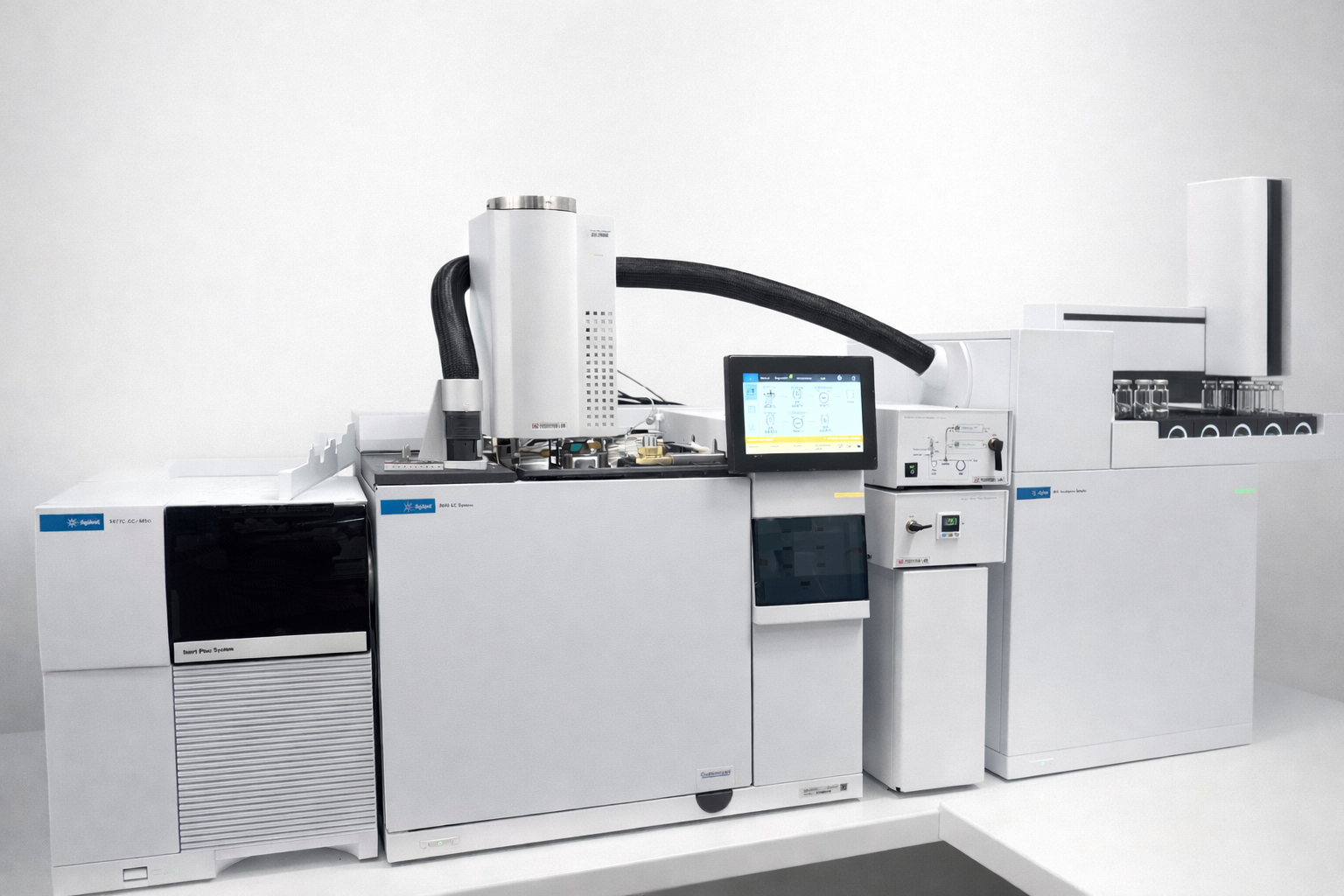
Pyrolysis Gas Chromatography Mass Spectrometry (Py-GCMS) is a powerful analytical technique for the identification and characterisation of non-volatile, insoluble and complex organic materials. Samples are rapidly decomposed at a very high temperature in an inert atmosphere to generate characteristic volatile fragments, which are subsequently separated by gas chromatography and identified by mass spectrometry. The resulting pyrolysis fingerprint provides detailed molecular information, enabling accurate identification of polymers, additives, degradation products, and complex organic mixtures. Py-GCMS requires minimal sample preparation and is particularly valuable for analysing plastics, rubbers, biomass, coatings, and environmental particulates that cannot be analysed directly by conventional GCMS.
Our Frontier Multi-Shot Pyrolyser integrated with Agilent GCMS provides exceptional flexibility for advanced thermal analysis and polymer characterisation. The system supports Single-Shot and Double-Shot modes, enabling comprehensive investigation of polymer composition, thermal degradation, additives, and volatile emissions within a single platform. Coupled with an autosampler, it requires minimal handling and sample preparation, ensuring a high throughput measurement.
Py-GCMS is widely used across environmental science, polymer engineering, materials science, forensic chemistry, recycling, pharmaceuticals, cultural heritage, and industrial quality control. It is particularly recognised as one of the most powerful techniques for microplastic identification and characterisation, enabling the determination of polymer type, additive composition, weathering products, and degradation mechanisms from particles down to the micron size. Applications include environmental microplastic monitoring in water, soil, air, sediments and biota, plastic recycling and circular economy research, tyre wear particles, polymer ageing, biomass conversion, pyrolysis product characterisation, contaminant source identification, and forensic analysis of synthetic materials.
Access and Operation
Internal (unimelb) users: Training and self-operation is the preferred option. Request via iLab Training Request.
External users: Fee-for-service is the preferred option. Submit Chem Node Analysis Requests via iLab Request Services.
Visit Chemistry Node Access and Operation for more details.
Training materials
Standard Operating Procedure (Pyroprobe CDS6150, Agilent GCMS)
Walkthrough (powerpoint slides for step-by-step software and instrument setup)
Experiment details (for researchers):
The equipment was a hyphenated pyrolysis gas chromatograph mass spectrometer (Frontier PY3030 pyrolyser; Agilent GCMS). The pyroprobe was set at a temperature of [600] °C and hold for [30] seconds. The interface, valve oven and GC transfer line were all set at 300 °C.
GC was equipped with an HP-5MS column. Its inlet was set at [250] °C with a split ratio of [10:1]. GC oven started at [40] °C and was holding for [1] minute. It then reached to [300] °C with a ramping rate at [20] °C/minute and held for [8] minutes. The MS used an electron impact ion source and scanned a range of [25-550] m/z with quad temperature at 150 °C and MS source temperature at 230 °C.
Note: values marked with [ ] should be replaced depending on actual experimental conditions.
Contact and Location
Dr Alex Duan (Platform Manager) | Dr Yukie O'Bryan (Technical specialist)
School of Chemistry, Building 154, The University of Melbourne, Victoria 3010