Inductively Coupled Plasma Optical Emission Spectrophotometer
Gas chromatograph is used to measure and quantify green house gases (N2O, CH4, CO2).
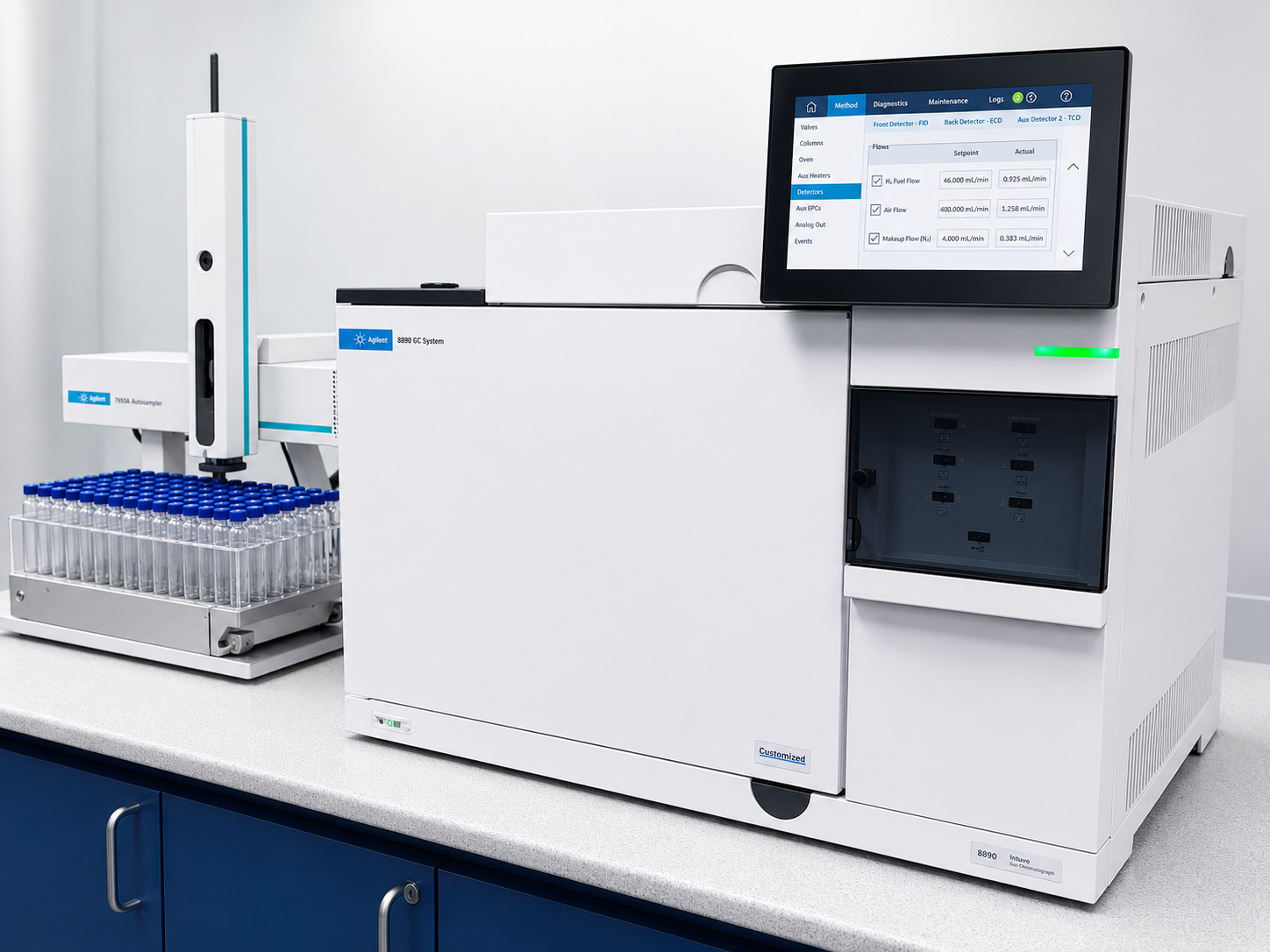
The Gas Chromatograph (GC) measures gaseous compounds such as green house gases and small hydrocarbons. The Agilent 8890A system is configured with three complementary detectors — thermal conductivity (TCD), micro electron capture (µECD), and flame ionisation (FID) — providing broad analytical capabilities across a wide range of applications. Automated sample introduction is achieved using a CTC PAL autosampler, which transfers pressurised gas samples from 20 mL Labco Exetainer® vials into pre-evacuated 12 mL vials before injection into dual 1 mL GC sample loops. The system is suitable for environmental, industrial, and research applications requiring accurate and reproducible gas analysis.
To ensure analytical quality, the GC loops and sample inlet are flushed with high-purity argon between analyses to eliminate carryover. Argon is used as the carrier gas for the TCD and FID, while P5 gas is used for the µECD. Each analytical batch is calibrated using NATA-certified gas mixtures, with segmented calibration curves applied over different concentration ranges to maximise accuracy. Instrument precision is routinely verified using 5 – 10 replicate analyses of laboratory air, achieving typical results of N₂O: 0.333 ± 0.005 ppm, CH₄: 4.07 ± 0.27 ppm, and CO₂: 494.6 ± 12.6 ppm. The system is also capable of analysing H₂ at concentrations above 20 ppm.
More information
- Contact person: Dr Jianlei Sun, Soil Node supervisor
- Access: find out more about accessing this equipment
- Location: School of Agriculture and Food, Building 184, The University of Melbourne, Victoria 3010