Inductively Coupled Plasma Optical Emission Spectrophotometer
Inductively coupled plasma optical emission spectrophotometer measures over 70 elements at trace level.
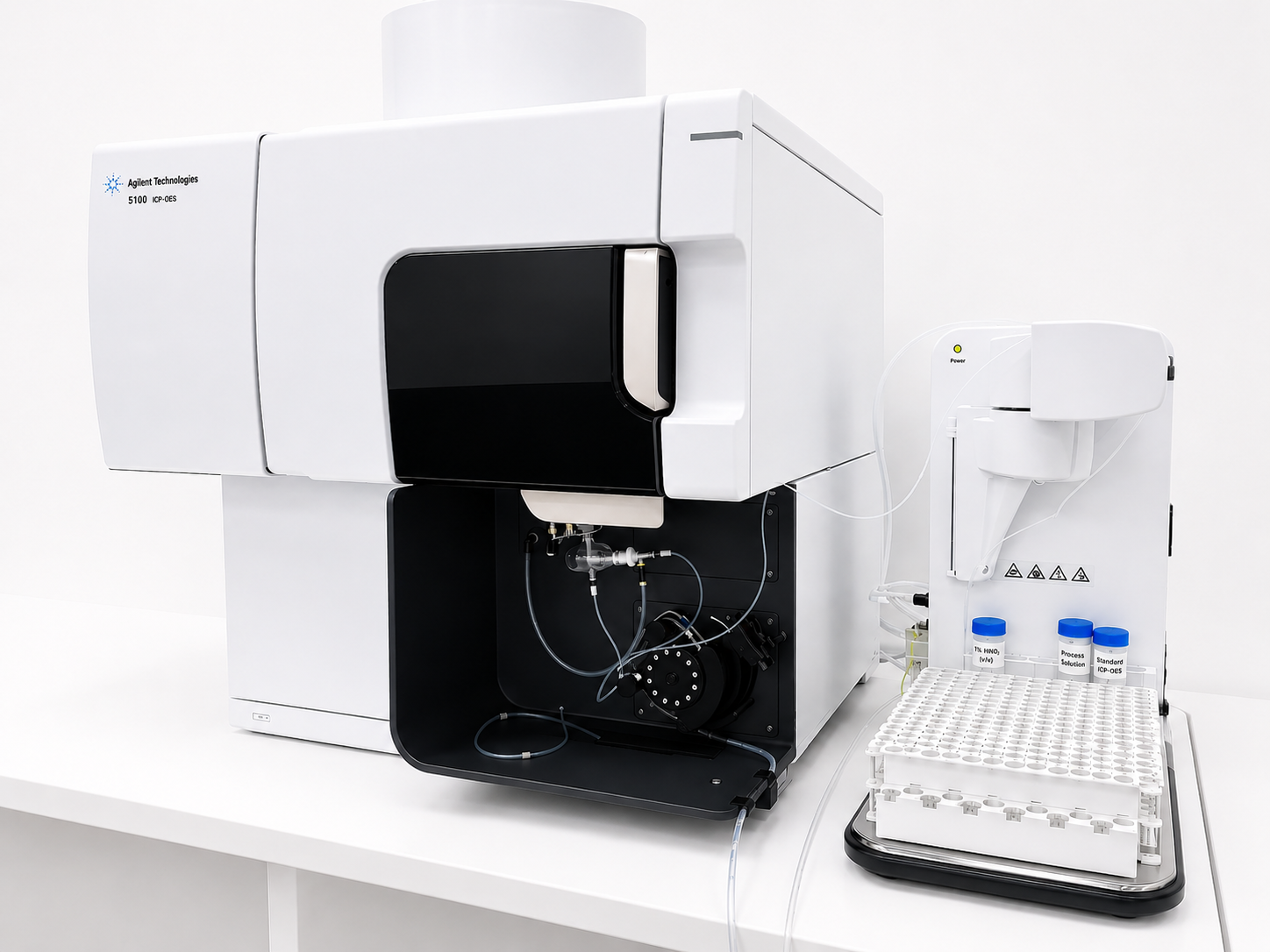
Inductively Coupled Plasma Optical Emission Spectrometry (ICPOES) is a robust, high-throughput technique for simultaneous multi-element analysis across a wide concentration range. Samples introduced into an argon plasma (6,000–8,000 K) are atomised and excited, producing element-specific optical emission that is measured to determine elemental concentrations. ICPOES combines excellent analytical performance with high productivity, making it an ideal technique for routine and research applications requiring accurate quantification from trace to major elemental concentrations in diverse sample matrices.
Our ICPOES (Agilent 5100 Dual View) combines high sensitivity with exceptional analytical speed through its innovative Synchronous Vertical Dual View (SVDV) technology. A unique Dichroic Spectral Combiner simultaneously captures axial and radial plasma emissions in a single measurement, delivering optimum sensitivity for trace elements while maintaining accurate analysis of major ions. The instrument features a high-resolution VistaChip II CCD detector, robust vertical torch design for high-matrix samples, low argon consumption, wide linear dynamic range, and rapid sample throughput, providing reliable performance for demanding analytical laboratories.
The ICPOES supports a broad range of analytical applications across environmental, mining, agriculture, food, pharmaceutical, geological, metallurgical, chemical manufacturing, and materials research. It is ideally suited for routine quality control, environmental compliance, elemental composition analysis, process monitoring, alloy characterisation, soil and plant analysis, water quality testing, and geochemical exploration. Its ability to accurately analyse complex, high dissolved solids samples with minimal matrix interference makes it a versatile platform for our advanced research environment.
Access and Operation
Internal (unimelb) users: Training and self-operation is the preferred option. Request via iLab Training Request.
External users: Fee-for-service is the preferred option. Submit Chem Node Analysis Requests via iLab Request Services.
Visit Chemistry Node Access and Operation for more details.
Training materials
Standard Operating Procedure (Agilent 5100)
Walkthrough (powerpoint slides for step-by-step software and instrument setup)
Contact and Location
Dr Alex Duan (Platform Manager) | Dr Yukie O'Bryan (Technical specialist)
School of Chemistry, Building 154, The University of Melbourne, Victoria 3010