Headspace Gas Chromatography Mass Spectrometer
Headspace Gas chromatography mass spectrometry is particularly useful to measure volatile organic compounds.
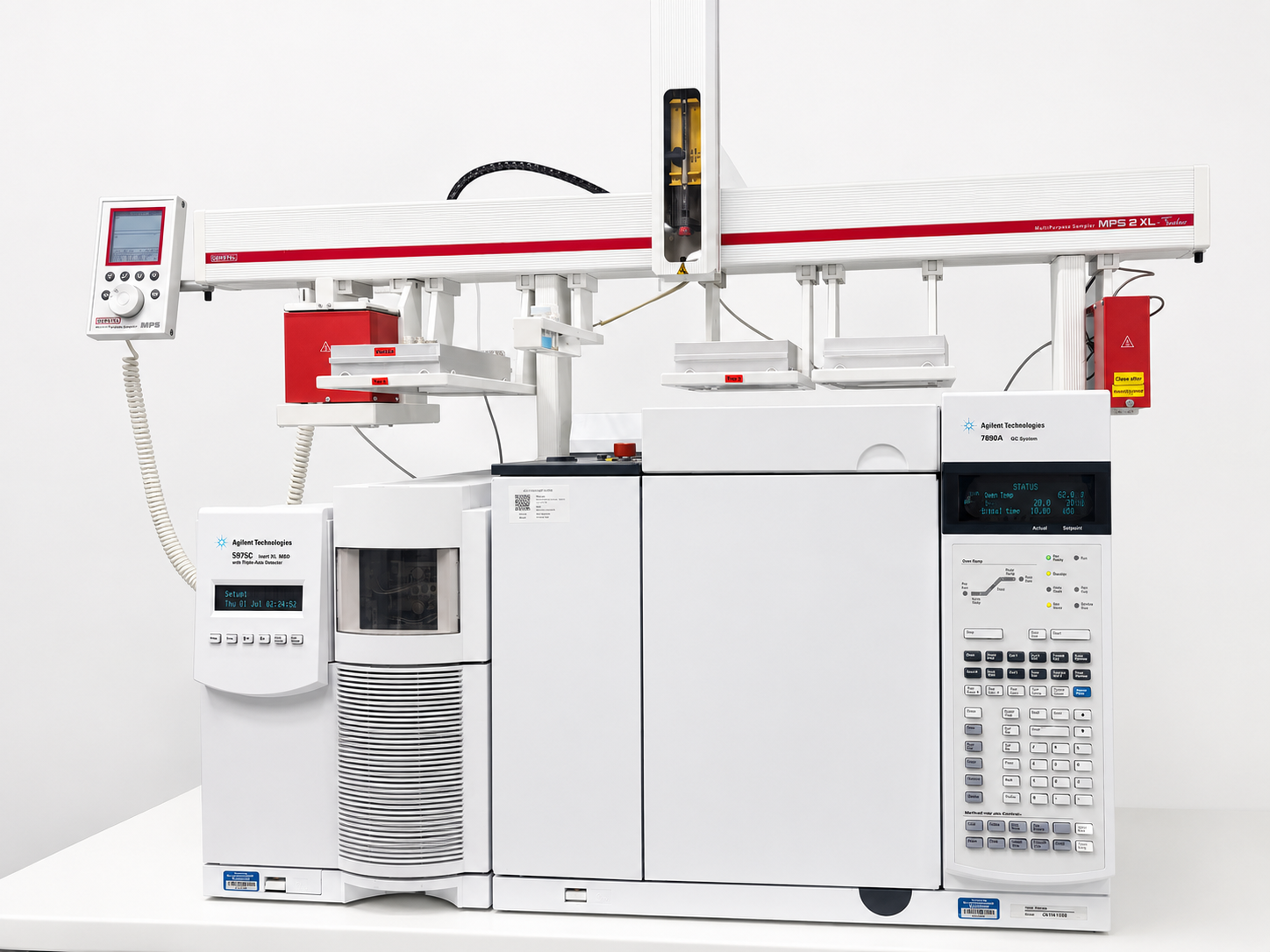
Headspace solid phase micro-extraction gas chromatography mass spectrometry (HS-SPME-GCMS) is a solvent-free sample preparation and analytical technique for the determination of volatile and semi-volatile organic compounds (VOCs and SVOCs). VOCs partition from the sample into the headspace, where they are selectively adsorbed onto a SPME fibre before thermal desorption in the GC inlet. The separated compounds are subsequently identified and quantified by mass spectrometry, providing highly sensitive, selective, and reproducible analysis while minimising sample preparation, solvent consumption, and analytical contamination.
Our platform features a Gerstel MultiPurpose Sampler (MPS) integrated with GCMS for fully automated headspace SPME analysis. The robotic system provides precise control of sample incubation, agitation, extraction (temperature and time), fibre conditioning and thermal desorption, ensuring high reproducibility and throughput operation. Coupled with a polyethylene glycol (WAX) capillary column, the system delivers excellent chromatographic separation of polar VOCs, including alcohols, aldehydes, ketones, esters, and organic acids.
Automated HS-SPME-GCMS is widely applied for VOC characterisation across environmental, food, agriculture, biomedical, forensic, pharmaceutical, and materials research. Typical applications include flavour and aroma profiling, food authenticity, drinking water quality, indoor air monitoring, soil and sediment contamination, breath analysis, microbial volatile metabolites and polymer degradation products. The technique is particularly valuable for trace VOC fingerprinting and environmental pollution studies, where automated sample handling and solvent-free extraction provide highly reproducible results with minimal matrix interference and contamination.
Access and Operation
Internal (unimelb) users: Training and self-operation is the preferred option. Request via iLab Training Request.
External users: Fee-for-service is the preferred option. Submit Chem Node Analysis Requests via iLab Request Services.
Visit Chemistry Node Access and Operation for more details.
Training materials
Headspace (Shimadzu) Standard Operating Procedure
Solid Phase MicroExtraction (SPME, Shimadzu) Standard Operating Procedure
Walkthrough (headspace and SPME operation)
Available services
Headspace volatile organic compounds (VOCs).
Contact and Location
Dr Alex Duan (Platform Manager) | Dr Yukie O'Bryan (Technical specialist)
School of Chemistry, Building 154, The University of Melbourne, Victoria 3010